

Gallery

A dockworker of Wampanoag and African descent, he was the first person shot to death by British Redcoats during the Boston Massacre, in Boston, Massachusetts on March 5, 1770. He has been called the first martyr of the revolution.

An American physician, surgeon and medical researcher. He researched in the field of blood transfusions, developing improved techniques for blood storage, and applied his knowledge to developing large-scale blood banks early in World War 11, allowing medics to save thousands of lives of the Allied forces.

A Barbadian politician who served as Premier of Barbados from April 17, 1958 to December 8, 1961. He was a member of the Barbados Labour Party (BLP). Dr. Cummins was a medical practitioner and one of the first Barbados Labour Party members of Parliament in 1940.

An American clergyman, activist, and a prominent leader in the African American Civil Rights Movement. He is best known for being an iconic figure in the advancement of civil rights in the United States and around the world, using nonviolent methods. He was assassinated in 1968 and is revered the world over. A holiday is named in his honor.

The first female pilot of African American decent and the first person of African American to hold an international pilot license. She refused a starring role in a movie because it would perpetuate the derogatory image most whites had of most blacks.

A Cuban revolutionary and politician, having held the position of Prime Minister of Cuba from 1959 to 1976, and then President from 1976 to 2008. He led a successful guerrilla war against Bastista’s forces, with Bastista fleeing into exile in 1959.

An African American abolitionist, social reformer, author, editor, diplomat, and statesman. After escaping from slavery, he became a leader of the abolitionist movement. He was recognized for his powerful speeches and sharp anti-slavery writing, serving as direct proof against slaveholder stereotypes.


An African American abolitionist, humanitarian, and Union spy during the American civil War. She was born into slavery, escaped and made thirteen missions to rescue more than seventy slaves using the network of antislavery activist and safe houses known as the underground Railroad. During the post-war era she struggled for women’s suffrage

A muslin minister and human rights activist, he was a courageous advocate for the rights of African Americans, a man who indicted white America in the harshest terms for its crimes against black Americans. He was assassinated at the Audubon Ballroom but remains a source of inspiration to African Americans.

A Jamaican publisher, journalist, entrepreneur, and orator who was a staunch proponent of Black Nationalism and Pan-Africanism movements. He founded the Universal Negro Improvement Association and African Communities League (UNIA-ACL) and the Black

An American educator and civil rights leader, best known for starting a school for African American students in Daytona Beach, Florida, that eventually became Bethune-Cookman University and for being an advisor to President Franklin D. Roosevelt.

A former professional boxer, philanthropist and social activist, he was considered a cultural icon. Ali was idolized after winning the World Heavyweight Championship in 1967. Three years later, he was publicly vilified for his refusal to be conscripted into the U.S. military, based on his religious beliefs and opposition to the Vietnam War.

The first black President of South Africa, he served from 1994 to 1999. Mandela was the first South African president to be elected in a fully representative democratic election. Before his presidency, he was an anti-apartheid activist, the leader of the armed wing of the African National Congress (ANC), and was imprisoned for 27 years.

An American concert singer (bass), recording artist, actor, athlete, and scholar. He was also an advocate for the Civil Rights Movement in the first half of the twentieth century. He gained international attention for his work in the arts, and he merged his artistic career with political activism.

An African American politician, educator, and author. She was a Congresswoman for seven terms from 1969 to 1983 and became the first black woman elected to congress. She became the first major-party black candidate for President of the United States and the first woman to run for the Democratic presidential nomination.

An African American abolitionist and women’s rights activist. Truth was born into slavery in New York but escaped with her infant daughter to freedom in 1826. After going to court to recover her son, she became the first black woman to win such a case against a white man. During the Civil War, Truth helped recruit black troops for the Union Army.

An African -American Jazz trumpeter and singer from New Orleans, Louisiana. Coming to prominence in the 1920s as an “inventive” cornet and trumpet player, Armstrong was a foundational influence in Jazz, shifting the music’s focus from collective improvisation to solo performance.

Sir Grantley Adams was the first Premier of Barbados. In 1938, he founded the Barbados Labour Party (BLP), which was then known as the Barbados Progressive League. Sir Grantley was President of the Barbados Workers’ Union (BWA) from 1941 to 1954. He became the first and only Prime Minister of the West Indies Federation.

A Bahamian American actor, film director, author, and diplomat. In 1963 Poitier became the first black person to win an Academy award for best Actor for his role in ‘Lilies of the Field’. In 1999, the American Film Institute named Poitier among the Greatest Male Stars of All Times, ranking 22nd on the list of 25.


An African American civil rights activist from Mississippi involved in the effort to overturn segregation at the University of Mississippi. He become active in the civil rights movement and was a field secretary for the NAACP. He was assassinated on June 12th 1963 in Jackson, Mississippi.


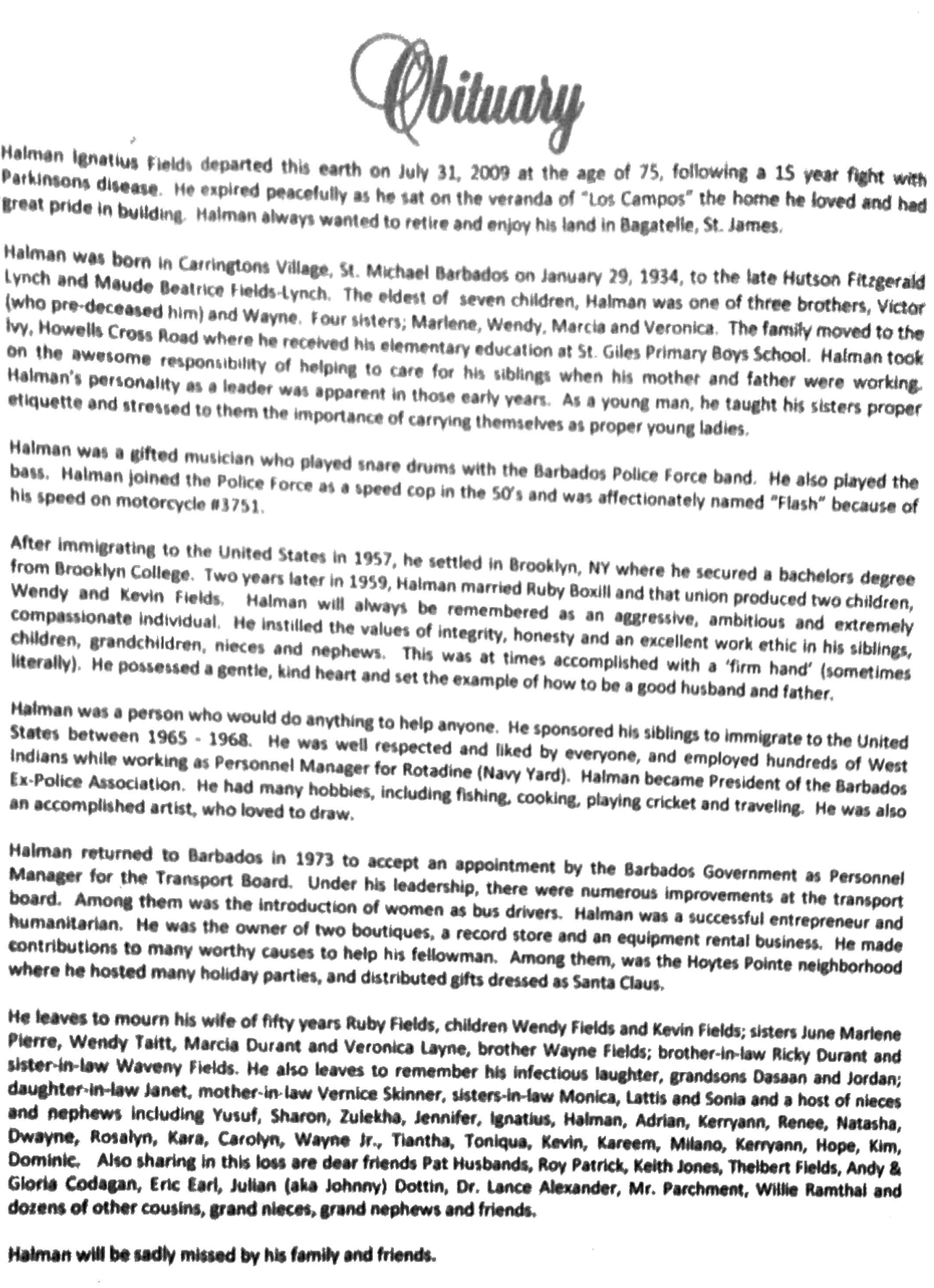
Halam was one of the founder members of the Barbadian ExPolice Association from its inception.